Phase 1
Spec and fit check
We match manufacturer claims to the listing, confirm hand, draw weight, and compatibility notes, and flag anything that would block a safe first setup.
Buyer-fit guidance (no numeric score) · how we research
Quick verdict: Michigan pre-season, warm afternoon at the target butt. A dozen arrows tipped with field points stacked tight. Then I screwed on the first 150 grain broadhead and it landed a hand's width low and left.
✓ Best for
Buy the pack for cheap backup heads or a low-cost 150 gr FOC test on a recurve or longbow. Stick with 100 grain heads if your arrows are spined for…
✕ Not for
Out-of-the-pack sharpness is inconsistent; budget steel usually needs a touch-up before you'd…
As an Amazon Associate we may earn from qualifying purchases. Commissions do not change scores. Affiliate disclosure.
The 10-Second Answer
Michigan pre-season, warm afternoon at the target butt.
Buyer fit
Best for: Buy the pack for cheap backup heads or a low-cost 150 gr FOC test on a recurve or longbow. Stick with 100 grain heads if your arrows are spined for…
Skip if: Out-of-the-pack sharpness is inconsistent; budget steel usually needs a touch-up before you'd…
No numeric research score — inputs are not documented for this review. How we research
Editor's Verdict
— jakemorrisonI swapped field points for these and my group jumped low and left right away. That's not a defect. It's what 50 percent more tip weight does to point of impact.
The edges were dull enough out of the pack that I'd touch them up before hunting, and paper-tuning took real work.
Here's my honest read: 150 grains isn't free penetration. It's a spine and sight-pin problem you solve before season. I'd keep these for stump shooting and hang a Muzzy on the arrow that matters.
Overview
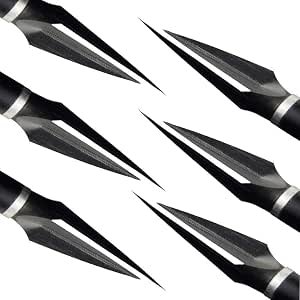
It's a fixed-blade head with no moving parts, unlike a mechanical that opens on impact. The screw-in ferrule threads into a standard insert, same as your field points.
At 150 grains it's aimed at traditional and recurve shooters who want front weight. Compound shooters use them too, but the arrow spine has to match the added tip weight.
Front-of-center is how much of the arrow's weight sits toward the tip. More weight up front raises FOC and momentum but weakens dynamic spine and drops speed, so the head hits a different spot than your field points.
Before you hunt: confirm spine, paper-tune, check broadhead flight, then re-sight at 20, 30, and 40 yards.
| Spec | Detail |
|---|---|
| Head weight | 150 grain |
| Blade type | Fixed-blade traditional |
| Mount | Screw-in, standard thread |
| Pack count | 6 |
| Construction | Steel blades |
| Compatibility | Compound, recurve, longbow |
| Price | |
| ASIN | B078WC2NFG |
| Head | Weight | Blade type | Sharp out of pack | Price/head | Best for |
|---|---|---|---|---|---|
| This budget 6-pack | 150 gr | Fixed | Inconsistent | ~$2 | Spares, practice, FOC |
| Muzzy Trocar | 100/125 gr | Fixed | Hunting-sharp | ~$12 | Primary fixed-blade hunt |
| Rage Hypodermic | 100/125 gr | Mechanical | Hunting-sharp | ~$13 | Big entry, fast compound |
Choose this pack for spares, practice, and FOC experiments. Choose a Muzzy Trocar for a proven fixed blade, a Rage Hypodermic for a large mechanical entry, or a G5 Montec for a durable one-piece.
[Check the Price on Amazon!](Check the Price on Amazon!)
Buy the pack for cheap backup heads or a low-cost 150 gr FOC test on a recurve or longbow. Stick with 100 grain heads if your arrows are spined for them and you won't re-tune.
Check your state's cutting-width and blade rules before any budget head goes on a hunting arrow.
Specs, Visualized
Summary: What a 150 Grain Traditional Broadhead Is It's a fixed-blade head with no moving parts, unlike a mechanical that opens on impact. The screw-in ferrule threads into a standard insert, same as your field points. At 150 grains it's aimed…
Strung length
20"
Fail any of these? Use the bow finder below →
How We Research
Summary: We verify listing specs, check owner feedback across Amazon and forums, and compare against bows and accessories we have already reviewed on Bow Advice.
Phase 1
We match manufacturer claims to the listing, confirm hand, draw weight, and compatibility notes, and flag anything that would block a safe first setup.
Phase 2
We read recent Amazon reviews and archery forum threads for repeat praise, repeat complaints, and gaps between marketing copy and real-world use.
Phase 3
We compare price, included accessories, and upgrade path against close competitors so the recommendation reflects value—not just brand loyalty.
Owner Consensus
Summary: Buyers like the low price, six-count backup value, and screw-in fit for practice and traditional-FOC use (synthesis, not quotes). Complaints cluster around dull, uneven edges and tuning headaches at 150…
Buyers like the low price, six-count backup value, and screw-in fit for practice and traditional-FOC use (synthesis, not quotes).
Complaints cluster around dull, uneven edges and tuning headaches at 150 grains. Sentiment skews positive for practice buyers, negative for anyone expecting a hunting-ready head.
Common praise
Common complaints
On the forums the questions repeat: do people hunt these or just practice, and how do they compare to Muzzy or Rage?
Consensus is practical. Cheap 150 gr packs get used as practice and spare heads. Muzzy and Rage win the primary shot, and everyone says touch up the edges first.
I swapped field points for these and my group jumped low and left right away. That's not a defect. It's what 50 percent more tip weight does to point of impact. The edges were dull enough out of the pack that I'd touch them up before hunting, and paper-tuning took…
Best for
Buy the pack for cheap backup heads or a low-cost 150 gr FOC test on a recurve or longbow. Stick with 100 grain heads if your arrows are spined for…
Not for
Out-of-the-pack sharpness is inconsistent; budget steel usually needs a touch-up before you'd…
Check price on Amazon →Bow Finder
Pick the profile that sounds like you. We point you to a living guide — not a scored ranking of this product.
Use-case path
Look for adjustable draw weight, a shelf or rest option, and a budget that still leaves room for arrows and a target. Begin with compound vs recurve, then a starter guide.
Next read
Starter guides — not a fit scoreUse-case path
Traditional shooters often want a smooth draw and simple setup. Takedown models let you swap limbs as you progress.
Next read
Traditional guides — not a fit scoreUse-case path
Hunters usually want let-off, sights, and adjustability. Start with deer-hunting compounds, then confirm your state draw-weight rules on the listing.
Next read
Hunting guides — not a fit scoreUse-case path
Youth bows should be light enough for small frames and adjustable enough to grow into. Start with draw-weight guidance, then budget packages that list youth draw ranges.
Next read
Youth path — not a fit scoreUse-case path
Competition paths vary by league. Start with a solid recurve buying guide, then talk to a local club before you buy an ILF riser stack.
Next read
Target path — not a fit scoreUse-case path
Budget does not mean bad. Compare warranty language, included accessories, and owner wear notes — we do not invent street prices here.
Next read
Budget guides — not a fit scoreBuyer Questions
The questions real buyers ask before ordering, answered from listings, manuals, and owner-feedback patterns — not a private lab.
Check price on Amazon →The pack runs about $13 for six heads, roughly $2 each. That's the whole appeal: cheap spares and practice heads that won't burn your premium broadheads.
They're worth it as backup, stump-shooting, and FOC-experiment heads, not as your primary hunting head. A Muzzy Trocar or Rage Hypodermic wins on out-of-pack sharpness and bone-hit durability.
Not reliably. Budget edges are inconsistent, so check and touch up every blade to shaving-sharp before you'd trust one on game.
Yes. Going from 100 to 150 grains is 50 percent more tip weight, which shifts point of impact and weakens dynamic spine. Paper-tune, check broadhead flight, and re-sight at 20, 30, and 40 yards first.
At 150 grains they're plenty heavy for whitetail penetration. Legality depends on your state's cutting-width and blade rules, so confirm the regs and sharpen each edge first.
For about $13 this six-pack earns its place as spares, stump-shooting heads, and traditional-FOC experiments. The honest ceiling is backup and practice, not replacing a Muzzy Trocar or Rage Hypodermic.
Whatever you hang on a hunting arrow, tune and re-sight it first. Heavy fixed blades earn trust at the range, not on the animal.
[Check the Price on Amazon!](Check the Price on Amazon!)