Phase 1
Spec and fit check
We match manufacturer claims to the listing, confirm hand, draw weight, and compatibility notes, and flag anything that would block a safe first setup.
Buyer-fit guidance (no numeric score) · how we research
Quick verdict: Last spring in my Michigan backyard, I had a left-handed 9-year-old who kept closing the wrong eye. Every bow on the rack was right-hand, so he'd been fighting his own aim for months.
✓ Best for
- Buy it for a left-handed or left-eye-dominant kid; that's the main reason it exists. - Buy it for a small beginner building form on light, forgiving poundage. - Buy…
✕ Not for
The 29-pound top end sits under most states' 40-pound deer minimum, so…
As an Amazon Associate we may earn from qualifying purchases. Commissions do not change scores. Affiliate disclosure.
The 10-Second Answer
Last spring in my Michigan backyard, I had a left-handed 9-year-old who kept closing the wrong eye.
Buyer fit
Best for: - Buy it for a left-handed or left-eye-dominant kid; that's the main reason it exists. - Buy it for a small beginner building form on light, forgiving poundage. - Buy…
Skip if: The 29-pound top end sits under most states' 40-pound deer minimum, so…
No numeric research score — inputs are not documented for this review. How we research
Editor's Verdict
— jakemorrisonI buy a first bow for handedness and fit, not for the price tag or the top-end poundage. A lefty kid on a right-hand bow learns to close the wrong eye and fight the string, and that habit takes a year to unlearn.
For a raw beginner, I set the weight near 10 to 15 pounds, low enough that the kid can draw ten times without their form falling apart.
Under real kid use around here, the frame took dropped bows and backyard abuse fine. It's louder than a tuned adult rig, but a couple of string dampeners quiet it down.
My quotable line: buy for how your kid shoots, not for what the box costs.
The real limit isn't the bow breaking. It's your kid outgrowing the 29-pound range before they outgrow the hobby.
Overview
| Spec | Detail |
|---|---|
| Draw weight | 10 to 29 lb, adjustable |
| Draw length | Youth range (confirm the current listing) |
| Price | Around $150 |
| Handedness | Left-hand |
| Color | Purple |
| ASIN | B0FRB6QXCM |
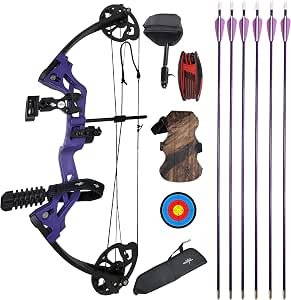
| Included | Bow, sight, arrow rest, peep, D-loop, fiberglass arrows |
The kit is built to get a young lefty shooting: a lightweight youth riser, a single cam with let-off, and the sight, rest, peep, D-loop, and arrows bundled in.
What still needs your attention is the tuning. Set the peep, mount and center the sight, square the rest, and tie in the D-loop before the first real practice session.
A true left-hand riser and cam aren't a gimmick. They set where the arrow sits, how the kid anchors, and how the string releases, all mirrored for a left-eye-dominant shooter.
Most cheap youth packages are right-hand only, so lefty kids learn to close their dominant eye or twist into the bow. That's the exact problem this model solves.
If you're still sizing up options, our compound bow buying guide covers fit before you spend. The common mistake is buying a right-hand bow for a lefty and hoping they adjust. They don't.
Fit is the whole game. Match draw length to your kid's arm span and draw weight to their frame, not to their age.
The 10-pound low end suits a young or small kid just starting out, and 29 pounds is where a stronger youth tops out. That range is a feature: start light, add weight as form holds.
Two mistakes I see: buying by age alone, and starting near 29 pounds before the kid's form is solid. Earn the pounds.
The roughly $150 bundle is genuinely enough to start a young shooter. The sight, rest, peep, D-loop, and arrows cover backyard and target work, and the arrows and rest are the parts you'll upgrade later.
A hand-picked bare bow plus your own accessories shoots better, but it costs more and takes know-how most first-time parents don't have yet. For other cheap starter options, our budget compound bow roundup lays out the trade-offs.
Here's where I get blunt. Most states set a 40-pound minimum draw weight for deer, so a 29-pound top end makes this a target and form bow, not a whitetail rig.
Treat 29 pounds as the ceiling, not headroom. Light poundage doesn't carry the kinetic energy for a clean, ethical shot on deer, which keeps this bow in the backyard and small-game lane.
If deer is the goal, start with our deer hunting compound picks instead. A 29-pound youth bow isn't a deer-hunting bow. It's a form-builder that happens to say "ready to hunt" on the box.
Against the Supreme Youth Compound Bow Package, the split is handedness. The Supreme Youth is a right-hand adjustable growth bundle with a higher top end, so a right-handed kid who'll grow into more poundage should look there first.
Against the Genesis Original from Genesis Archery, you're weighing zero let-off and a one-size NASP school standard. Genesis wins for school programs and dead-simple setup, but it makes a small shooter hold full weight to aim.
Against the Diamond Atomic from Diamond Archery, it's name-brand adjustable growth with pro-shop support. Pay up for the Atomic when you want a dealer to fit and tune it for years.
Don't assume any small youth bow fits. Fit is handedness plus draw length and weight, not overall size.
Specs, Visualized
Summary: Specs and What's in the Box | Spec | Detail | |------|--------| | Draw weight | 10 to 29 lb, adjustable | | Draw length | Youth range (confirm the current listing) | | Price | Around $150 | |…
Our pick for most adults: 29 lbs. Take the 15-second draw weight test →
Fail any of these? Use the bow finder below →
How We Research
Summary: We verify listing specs, check owner feedback across Amazon and forums, and compare against bows and accessories we have already reviewed on Bow Advice.
Phase 1
We match manufacturer claims to the listing, confirm hand, draw weight, and compatibility notes, and flag anything that would block a safe first setup.
Phase 2
We read recent Amazon reviews and archery forum threads for repeat praise, repeat complaints, and gaps between marketing copy and real-world use.
Phase 3
We compare price, included accessories, and upgrade path against close competitors so the recommendation reflects value—not just brand loyalty.
Owner Consensus
Summary: Parents keep coming back to the same praise: a true left-hand option they couldn't find elsewhere, an easy light draw for small kids, and real value near $150. The recurring…
Parents keep coming back to the same praise: a true left-hand option they couldn't find elsewhere, an easy light draw for small kids, and real value near $150.
The recurring complaints are just as steady. Setup takes fiddling, the accessories are starter grade, and the included arrows are the first thing most buyers replace.
Common praise
Common complaints
I buy a first bow for handedness and fit, not for the price tag or the top-end poundage. A lefty kid on a right-hand bow learns to close the wrong eye and fight the string, and that habit takes a year to unlearn. For a raw beginner, I set the…
Best for
- Buy it for a left-handed or left-eye-dominant kid; that's the main reason it exists. - Buy it for a small beginner building form on light, forgiving poundage. - Buy…
Not for
The 29-pound top end sits under most states' 40-pound deer minimum, so…
Check price on Amazon →Bow Finder
Pick the profile that sounds like you. We point you to a living guide — not a scored ranking of this product.
Use-case path
Look for adjustable draw weight, a shelf or rest option, and a budget that still leaves room for arrows and a target. Begin with compound vs recurve, then a starter guide.
Next read
Starter guides — not a fit scoreUse-case path
Traditional shooters often want a smooth draw and simple setup. Takedown models let you swap limbs as you progress.
Next read
Traditional guides — not a fit scoreUse-case path
Hunters usually want let-off, sights, and adjustability. Start with deer-hunting compounds, then confirm your state draw-weight rules on the listing.
Next read
Hunting guides — not a fit scoreUse-case path
Youth bows should be light enough for small frames and adjustable enough to grow into. Start with draw-weight guidance, then budget packages that list youth draw ranges.
Next read
Youth path — not a fit scoreUse-case path
Competition paths vary by league. Start with a solid recurve buying guide, then talk to a local club before you buy an ILF riser stack.
Next read
Target path — not a fit scoreUse-case path
Budget does not mean bad. Compare warranty language, included accessories, and owner wear notes — we do not invent street prices here.
Next read
Budget guides — not a fit scoreBuyer Questions
The questions real buyers ask before ordering, answered from listings, manuals, and owner-feedback patterns — not a private lab.
Check price on Amazon →It's a genuine left-hand, purple, ready-to-hunt youth compound kit from Southland Archery Supply, built for small and beginner archers. It runs around $150, adjusts from 10 to 29 pounds, and lists under ASIN B0FRB6QXCM.
It's a genuine left-hand build, with the riser and cam mirrored for a left-eye-dominant or left-handed shooter. That's the main reason to buy it over a right-hand youth package a lefty has to fight.
It adjusts from 10 to 29 pounds of draw weight across a youth draw-length range. Confirm the exact draw length on the current listing and match it to your kid's arm span before you order.
It's best for a young or small beginner whose draw length and frame land inside that range, roughly early grade-school size, not a set age. Measure draw length first, then start near the 10-pound low end.
It costs around $150 and comes with a sight, arrow rest, peep, D-loop, and fiberglass arrows. Expect starter-grade parts you'll upgrade, especially the arrows and rest, as the kid progresses.
No, 29 pounds sits under most states' 40-pound deer minimum, so treat this as a target and small-game bow. It's built to build clean form in the backyard, not to take whitetail.
Buy the SAS Hero Junior for a left-handed or small beginner who needs light, form-building poundage. Pick the Supreme Youth for a right-hand grow-into bundle, the Genesis for school-program simplicity, or the Diamond Atomic for a name-brand growth bow with pro-shop support.
For a lefty or a small beginner, this is a real first bow, not a toy. The genuine left-hand build and light, form-building poundage are the reason to buy near $150.
The caveats are setup and the 29-pound ceiling, not durability. Dial in the peep, sight, rest, and D-loop before the first session, and keep this bow in the target and small-game lane.
If you'd rather go another way: pick the Supreme Youth for a right-hand grow-into bundle, the Genesis for a school-program standard, or the Diamond Atomic for a name-brand growth bow with dealer support.
[Check the Price on Amazon!](Check the Price on Amazon!)